Simple "motion model" with no dynamics for parameter estimation. More...
#include <parameter_estimator.hpp>
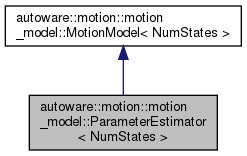
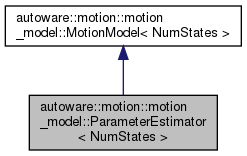
Public Member Functions | |
| ParameterEstimator & | operator= (const ParameterEstimator &rhs) |
| Default assignment operator. More... | |
| void | predict (Eigen::Matrix< float32_t, NumStates, 1U > &x, const std::chrono::nanoseconds &dt) const override |
| Do motion based on current state, store result somewhere else. This is intended to be used with motion planning/collision avoidance i.e. to make multiple calls to predict with different time deltas for a rollout to get a concrete representation of predicted trajectories. This function does not mutate the core state of the motion model, and should only mutate some cached worker variables at most. More... | |
| void | predict (const std::chrono::nanoseconds &dt) override |
| Update current state with a given motion. Note that this should be called after compute_jacobian() as it will change the object's state. This is meant to be called before doing assignment and observation updating. This is the equivalent of temporal update for the state. This function mutates the core state of the motion model. More... | |
| void | compute_jacobian (Eigen::Matrix< float32_t, NumStates, NumStates > &F, const std::chrono::nanoseconds &dt) override |
| Compute the jacobian based on the current state and store the result somewhere else. More... | |
| void | compute_jacobian_and_predict (Eigen::Matrix< float32_t, NumStates, NumStates > &F, const std::chrono::nanoseconds &dt) override |
| This is called by Esrcf. This should be first a computation of the jacobian, and then a motion to update the state. This is a distinct function because depending on the motion model, there is some caching and optimization that can be done computing both the motion and jacobian together. More... | |
| float32_t | operator[] (const motion_model::index_t idx) const override |
| Get elements of the model's state. More... | |
| void | reset (const Eigen::Matrix< float32_t, NumStates, 1U > &x) override |
| Set the state. More... | |
| const Eigen::Matrix< float32_t, NumStates, 1U > & | get_state () const override |
| const access to internal state More... | |
 Public Member Functions inherited from autoware::motion::motion_model::MotionModel< NumStates > Public Member Functions inherited from autoware::motion::motion_model::MotionModel< NumStates > | |
| constexpr index_t | get_num_states () const noexcept |
| get dimensionality of this model More... | |
| virtual | ~MotionModel ()=default |
| Destructor. More... | |
Detailed Description
template<int32_t NumStates>
class autoware::motion::motion_model::ParameterEstimator< NumStates >
Simple "motion model" with no dynamics for parameter estimation.
- Template Parameters
-
NumStates dimensionality of this model's state space
Member Function Documentation
◆ compute_jacobian()
|
inlineoverridevirtual |
Compute the jacobian based on the current state and store the result somewhere else.
- Parameters
-
[out] F matrix to store jacobian into [in] dt prediction horizon to build jacobian off of
Implements autoware::motion::motion_model::MotionModel< NumStates >.
◆ compute_jacobian_and_predict()
|
inlineoverridevirtual |
This is called by Esrcf. This should be first a computation of the jacobian, and then a motion to update the state. This is a distinct function because depending on the motion model, there is some caching and optimization that can be done computing both the motion and jacobian together.
- Parameters
-
[out] F matrix to store jacobian into [in] dt prediction horizon to build jacobian off of
Implements autoware::motion::motion_model::MotionModel< NumStates >.
◆ get_state()
|
inlineoverridevirtual |
const access to internal state
- Returns
- const reference to internal state vector
Implements autoware::motion::motion_model::MotionModel< NumStates >.
◆ operator=()
|
inline |
Default assignment operator.
- Parameters
-
[in] rhs Object to copy
- Returns
- reference to this object
◆ operator[]()
|
inlineoverridevirtual |
Get elements of the model's state.
- Parameters
-
[in] idx index of state variable to get
- Returns
- copy of state variable
Implements autoware::motion::motion_model::MotionModel< NumStates >.
◆ predict() [1/2]
|
inlineoverridevirtual |
Update current state with a given motion. Note that this should be called after compute_jacobian() as it will change the object's state. This is meant to be called before doing assignment and observation updating. This is the equivalent of temporal update for the state. This function mutates the core state of the motion model.
- Parameters
-
[in] dt prediction horizon based on current state
Implements autoware::motion::motion_model::MotionModel< NumStates >.
◆ predict() [2/2]
|
inlineoverridevirtual |
Do motion based on current state, store result somewhere else. This is intended to be used with motion planning/collision avoidance i.e. to make multiple calls to predict with different time deltas for a rollout to get a concrete representation of predicted trajectories. This function does not mutate the core state of the motion model, and should only mutate some cached worker variables at most.
- Parameters
-
[out] x vector to store result into [in] dt prediction horizon based on current state
Implements autoware::motion::motion_model::MotionModel< NumStates >.
◆ reset()
|
inlineoverridevirtual |
Set the state.
- Parameters
-
[in] x the state to store internally
Implements autoware::motion::motion_model::MotionModel< NumStates >.
The documentation for this class was generated from the following file: