autoware::prediction::Time< kTimeReferenceFrame > Class Template Reference
This class describes a time point with respect to some time reference frame. More...
#include <time.hpp>
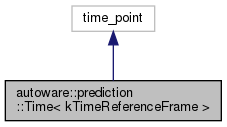
Inheritance diagram for autoware::prediction::Time< kTimeReferenceFrame >:
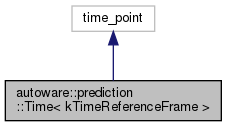
Collaboration diagram for autoware::prediction::Time< kTimeReferenceFrame >:
Public Member Functions | |
| Time ()=default | |
| Default contructor. More... | |
| Time (const Base &time_point) | |
| Constructs a new instance from a time_point. More... | |
| common::types::bool8_t | is_valid () const noexcept |
| Determines if the stored time_point is valid. More... | |
Friends | |
| Time | operator+ (Time time_1, const Time &time_2) |
| Add an operator + for two time points. More... | |
| template<typename IntT , typename DurationT > | |
| Time | operator+ (const Time &time, const std::chrono::duration< IntT, DurationT > &duration) |
| Overload operator +. More... | |
| template<typename IntT , typename DurationT > | |
| Time | operator- (const Time &time, const std::chrono::duration< IntT, DurationT > &duration) |
| Overload operator -. More... | |
Detailed Description
template<TimeReferenceFrame kTimeReferenceFrame>
class autoware::prediction::Time< kTimeReferenceFrame >
This class describes a time point with respect to some time reference frame.
- Template Parameters
-
kTimeReferenceFrame A reference frame for the stored time_point.
Constructor & Destructor Documentation
◆ Time() [1/2]
template<TimeReferenceFrame kTimeReferenceFrame>
|
default |
Default contructor.
◆ Time() [2/2]
template<TimeReferenceFrame kTimeReferenceFrame>
|
inlineexplicit |
Constructs a new instance from a time_point.
- Parameters
-
[in] time_point A time point.
Member Function Documentation
◆ is_valid()
template<TimeReferenceFrame kTimeReferenceFrame>
|
inlinenoexcept |
Determines if the stored time_point is valid.
- Returns
- True if valid, False otherwise.
Friends And Related Function Documentation
◆ operator+ [1/2]
template<TimeReferenceFrame kTimeReferenceFrame>
template<typename IntT , typename DurationT >
|
friend |
Overload operator +.
        We cannot use the operator for the base class as we want to still return Time, not
        an ordinary std::chrono::time_point.
- Parameters
-
[in] time The base time point. [in] duration The duration to add to the time point.
- Template Parameters
-
IntT Help integer type to pass into the duration template. DurationT Type of ratio used as a duration.
- Returns
- A new time point which represents the input time with duration added to it.
- Note
- This must be templated as otherwise the compiler gets confused as to which overload to pick in case the duration is not std::chrono::nanoseconds. If it does not match then the duration parameter matches better with an overload from std::chrono, while the first argument matches this class better. The compiler cannot pick the best one and throws a warning. Thus we template this function to make this choice ideal when used with Time class.
◆ operator+ [2/2]
template<TimeReferenceFrame kTimeReferenceFrame>
|
friend |
Add an operator + for two time points.
- Returns
- A new time point which is a sum of input ones.
◆ operator-
template<TimeReferenceFrame kTimeReferenceFrame>
template<typename IntT , typename DurationT >
|
friend |
Overload operator -.
        We cannot use the operator for the base class as we want to still return Time, not
        an ordinary std::chrono::time_point.
- Parameters
-
[in] time The base time point. [in] duration The duration to subtract from the time point.
- Template Parameters
-
IntT Help integer type to pass into the duration template. DurationT Type of ratio used as a duration.
- Returns
- A new time point which represents the input time with duration subtracted from it.
- Note
- This must be templated as otherwise the compiler gets confused as to which overload to pick in case the duration is not std::chrono::nanoseconds. If it does not match then the duration parameter matches better with an overload from std::chrono, while the first argument matches this class better. The compiler cannot pick the best one and throws a warning. Thus we template this function to make this choice ideal when used with Time class.
The documentation for this class was generated from the following file: